

Last Updated: October 30, 2026
Quick Summary
Handmade skincare is better for some people and worse for others, depending on what they need. Handmade products usually win on ingredient transparency and small-batch care, while commercial products usually win on consistency, stability and long-term testing.
- Natural describes where an ingredient came from, not whether it is safe for your skin.
- Essential oils and fragrance components are common sensitizers; limonene and linalool are frequent allergens.
- Handmade" and "artisan" are marketing terms, not regulated certifications in most markets.
- Handmade skincare shelf life is usually shorter and less predictable than commercial shelf life.
- Run a patch test on the inner forearm over two or three days before using any new product.
Table of Contents
- Handmade vs Commercial Skincare: What Actually Differs
- Does Natural Mean Safer? Separating Myth From Evidence
- The Benefits of Natural Skincare Ingredients, Honestly Weighed
- Preservation, Contamination and Handmade Skincare Shelf Life
- How to Identify High-Quality Natural Skincare
- Matching Skincare Type to Your Skin Type and Goals
- Choosing Your Next Step: Trying The Artisan Square Range
- Frequently Asked Questions
Handmade vs Commercial Skincare: What Actually Differs
Handmade skincare is better than commercial skincare for some people and worse for others, and the difference comes down to what you need from a product.
The gap between the two categories is real, but it is often misunderstood. Handmade skincare is typically made in small batches, often with fewer preservatives and shorter ingredient lists. Commercial skincare is produced at scale, tested for stability and preservation, and formulated to behave the same way across thousands of units.
Consider the Foaming Coffee Sugar Scrub Face & Body Exfoliator, an 8 oz product built around sugar and coffee powder. Its listed ingredients are short and easy to read, which is one of the advantages small-batch products can offer.
Does Natural Mean Safer? Separating Myth From Evidence
Natural does not automatically mean safer, and synthetic does not automatically mean harmful. That sentence appears in almost every article on this topic, so this section goes a level deeper: which specific ingredients actually cause problems, why, and how to read a label with that in mind.
The Cleveland Clinic makes the broad point directly, noting that natural ingredients are not automatically better or safer for skin and that plant-derived ingredients can still trigger reactions, according to Cleveland Clinic guidance on natural skin care products. What that guidance implies, and what most comparisons skip, is that "natural" is a sourcing claim, not a safety claim.
The natural ingredients most likely to cause reactions
A short, specific list is more useful than a general warning:
- Essential oils and fragrance components. Lavender, citrus peel oils, peppermint, tea tree and eucalyptus are common sensitizers. Limonene and linalool, naturally present in many essential oils, are among the most frequently reported fragrance allergens and must be declared on ingredient lists in many markets once they exceed set thresholds.
- Botanical extracts and plant proteins. Chamomile, calendula and similar extracts are generally soothing but can cause contact reactions in people with plant allergies, particularly those sensitive to the daisy family.
- Cold-pressed nut and seed oils. These are usually well tolerated, but nut-derived oils are a concern for people with genuine nut allergies, and unrefined oils can vary batch to batch.
- "Clean" preservative alternatives. Grapefruit seed extract and some essential-oil blends are marketed as natural preservatives but have weak and inconsistent antimicrobial activity, which is a safety issue in itself (more on that in the preservation section below).
The synthetic ingredients that are often gentler
Synthetic is a manufacturing description, not a hazard label. Several synthetic ingredients are widely used in skincare:
- Petrolatum and mineral oil. Highly refined cosmetic grades are among the most thoroughly studied occlusives in dermatology and are used in barrier-repair products for eczema-prone skin.
- Silicones such as dimethicone. They reduce water loss and improve slip, with a long safety record and low irritation potential.
- Hyaluronic acid and glycerin. Glycerin can be plant-derived or synthetic; the molecule is identical either way, and humectants like these are among the best-evidenced moisturizing ingredients available.
Peninsula Dermatology makes a related point, noting that synthetic formulations often offer consistency, stability and proven effectiveness, while natural ingredients can be soothing and appealing to many people, as described in Peninsula Dermatology comparison of natural and synthetic skincare. The practical takeaway is not "choose one side" but "judge the formulation."
A label-reading test that actually separates the two
Instead of asking whether an ingredient is natural, ask three questions:
- Is the ingredient list complete and in descending order of concentration? A short list is only reassuring if it is honest and complete.
- Is there a real preservation system? Water-containing products need one, whether the preservative is naturally derived or synthetic.
- Is the claimed hero ingredient high enough on the list to matter? A botanical listed after fragrance and preservatives is likely present in a token amount.
The table below sums up which ingredient types the article flags as likely to cause reactions and which it describes as gentler.
| Ingredient type | Examples named | Why it matters |
|---|---|---|
| Essential oils and fragrance components | Lavender, citrus peel oils, peppermint, tea tree, eucalyptus | Common sensitizers; limonene and linalool are frequent allergens |
| Botanical extracts | Chamomile, calendula | Can cause contact reactions, especially in people allergic to the daisy family |
| Cold-pressed nut and seed oils | Nut-derived oils | Concern for people with nut allergies; batch variation |
| Natural preservative alternatives | Grapefruit seed extract, some essential-oil blends | Weak and inconsistent antimicrobial activity |
| Synthetic ingredients often gentler | Petrolatum, dimethicone, hyaluronic acid, glycerin | Well-studied, low irritation potential, long safety record |
The Benefits of Natural Skincare Ingredients, Honestly Weighed
Natural ingredients can offer real benefits, but the benefits are narrower than marketing often suggests. Shea butter, for example, is a rich, fatty butter that many people use for moisture.
Be cautious with broad claims. A botanical extract in a product does not guarantee the result on the label. The concentration matters, and most natural products contain small amounts of their featured ingredient alongside a base of fats, water and preservatives.
Aromatherapy and natural fragrance also deserve a balanced view. Scent can make a routine more enjoyable, which matters for consistency, but fragrance is also a common source of irritation for sensitive skin.
Preservation, Contamination and Handmade Skincare Shelf Life
This is where handmade skincare needs the most scrutiny. Water-based products can grow bacteria and mould if they are not properly preserved, and small makers must balance preservation with the wish for gentler formulas. The Foaming Coffee Sugar Scrub lists phenoxyethanol and ethylhexylglycerin as preservatives.
Foaming Coffee Sugar Scrub Face & Body Exfoliator →
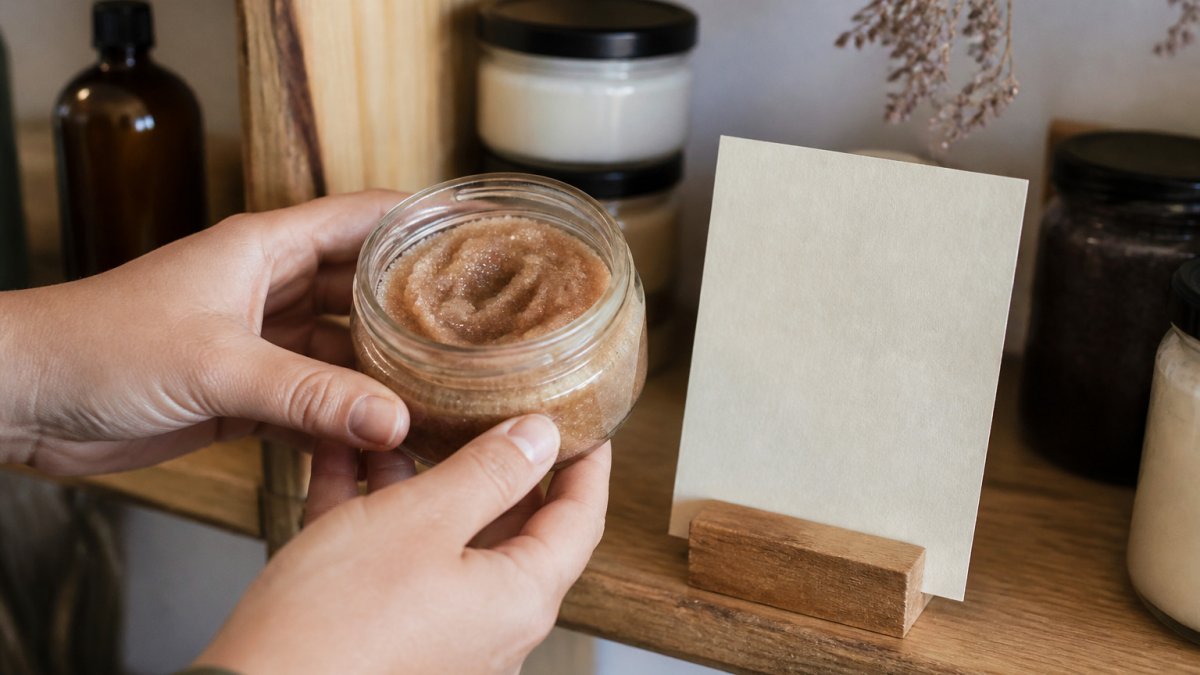
Handmade skincare shelf life is usually shorter and less predictable than commercial shelf life, because commercial brands run stability and challenge testing that most small batches cannot.
Our body bars and scrubs are made with this trade-off in mind. Use the dates and storage guidance on each product, and do not use a product past its useful life simply because it looks fine.
How to Identify High-Quality Natural Skincare
Reading the ingredient list and checking who made the product are good starting points. This section explains what labels and regulations generally mean, and how to separate meaningful standards from marketing language.
What "handmade" legally means (and does not mean)
In most markets, "handmade," "artisan" and "small-batch" are marketing terms, not regulated certifications. They carry no defined production, testing or ingredient standard. A product can be made in a small kitchen or a large factory and still be called handmade. That does not make the term useless, but it means you have to verify the claims behind it yourself.
What is regulated, depending on where you live, is different: cosmetic products generally must list ingredients using standardized naming (INCI names), declare allergens above set thresholds, and avoid prohibited substances. Rules vary by country, so a label that is compliant in one market may not meet the standard in another.
What organic certification actually verifies
An organic label is only meaningful if it is backed by a recognized certifier. Certification typically covers agricultural ingredients and how they were grown and processed, not the safety or effectiveness of the finished product. A certified-organic claim on a raw ingredient such as shea butter or argan oil tells you something about farming and processing; it does not tell you the finished cream is gentler or more effective. Be cautious with "contains organic ingredients" wording, which can apply to a product where only a small fraction of the formula is certified.
A practical checklist for judging any product
Use the same framework for handmade and commercial products:
- Formulation: Is the full ingredient list published, in descending order, with a clear preservation system for any water-containing product?
- Evidence: Is the hero ingredient present at a concentration where it could plausibly work, and is there real evidence behind that ingredient rather than a story?
- Safety: Are common allergens declared, and does the maker give storage and shelf-life guidance?
- Cost per use: Compare the price against how many uses you actually get, not just the sticker price. A concentrated bar or balm can cost less per use than a large bottle of dilute product.
- Suitability: Does the product match your skin type and any conditions you have, rather than just your values?
- Transparency: Does the maker name who produces the product, where, and how key ingredients such as shea and argan are sourced and paid for?
Consistency is a quality signal
A good small maker should aim to produce the same product the same way each time. Ask how any maker tests stability and preservation, and whether they keep batch records.
Matching Skincare Type to Your Skin Type and Goals
Your skin type should guide the choice more than any label. People who want gentle exfoliation may prefer a sugar-based scrub, such as the Matcha Face & Body Sugar Scrub or the Foaming Coffee Sugar Scrub, used two to three times a week. Those interested in a bar soap may consider the Sulfur & Chamomile Mineral Soap.
If you have a skin condition, eczema, rosacea or a history of allergic reaction, speak with a dermatologist before trying new products, handmade or not. Scrubs can aggravate inflamed or broken skin, so avoid using them on irritated areas.
Choosing Your Next Step: Trying The Artisan Square Range
If you want to test the handmade approach, start small. Try one scrub and one bar soap, patch test them, and see how your skin responds over two to three weeks. That gives you a fair comparison without committing to a full routine.
Our range is built around clear ingredient lists and small-batch care. Explore the Foaming Coffee Sugar Scrub, the Matcha Face & Body Sugar Scrub, the Moringa Body Bar, the Sulfur & Chamomile Mineral Soap and the Whipped Shea Butter, and decide for yourself whether handmade suits your skin.
Frequently Asked Questions
Are natural skin care products better?
Not automatically. Cleveland Clinic notes that natural ingredients are not inherently better or safer than other ingredients, and that they can still cause reactions. Handmade and natural products can suit some people well, especially those who prefer simple ingredient lists. The practical test is the ingredient list itself: check for ingredients you react to, read preservatives and fragrance declarations, and try a patch test before using a new product on your face or body.
Does handmade skincare have a shorter shelf life than commercial products?
It can vary by product, and storage and handling affect how long any product stays good. Some handmade items contain preservatives such as phenoxyethanol, as listed in our Foaming Coffee Sugar Scrub, which helps protect against microbial growth. Check the date and storage instructions on each product, keep scrubs dry and away from heat, and discard any product that changes smell, colour or texture.
What should you look for in high-quality handmade skincare ingredients?
Look for a full, readable ingredient list with common names and botanical names, such as Sucrose (Sugar) and Camellia Sinensis (Matcha Green Tea) Powder. Clear preservation information and directions for use signal transparency. Be cautious with vague claims like 'all natural' without a list. No single ingredient guarantees results for every skin type.
Is 'natural' always safer than 'chemical' in skincare formulations?
No. The idea that natural equals safe and synthetic equals harmful is a misconception. Plant-derived ingredients can irritate or trigger allergic reactions. Safety depends on the specific ingredient, concentration and your own skin. Product listings such as the Matcha Face & Body Sugar Scrub advise discontinuing use if irritation occurs, which applies to every formulation, handmade or commercial.
